
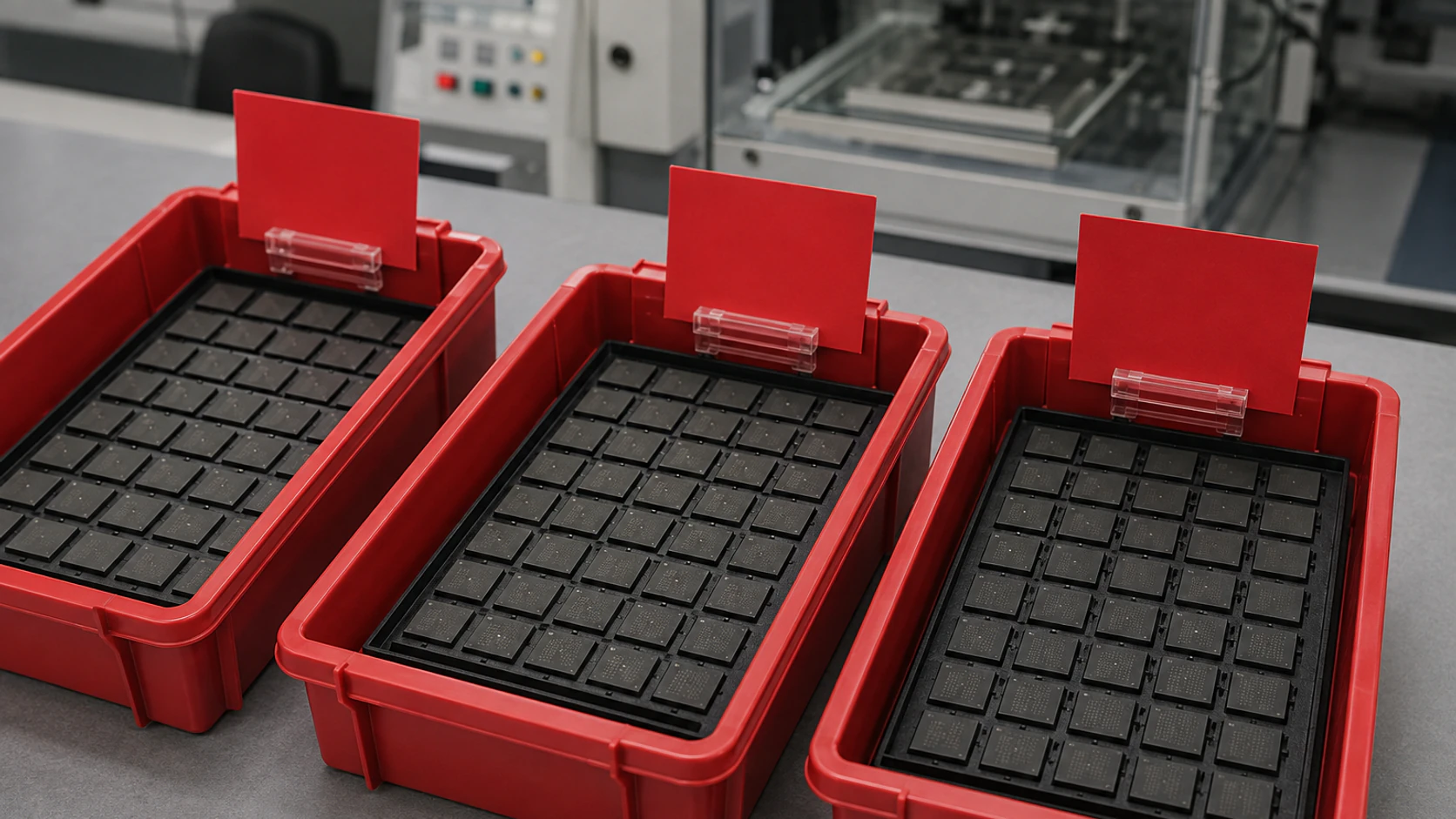
Condition labels affect the whole review
Factory excess, obsolete inventory and test rejects are not interchangeable. Their origin, handling history, supporting records, uncertainty and possible next steps differ.
A condition label should describe known facts rather than a desired value. Correct classification helps determine what documentation, sample verification and operating route may be needed.
Factory excess inventory
Factory excess generally describes materials produced or purchased beyond the current manufacturing requirement. It may result from forecast changes, overproduction, program completion or an altered bill of materials.
Useful records include the part list, quantity, original packaging, lot information, storage history and authority to dispose. “Excess” describes the commercial situation; it does not by itself establish authenticity, electrical condition or marketability.
Obsolete inventory
Obsolete inventory is no longer needed by the holder or is no longer aligned with a current product program. Commercial obsolescence does not always mean physical deterioration, but age, storage, moisture control, packaging and demand fit become important review factors.
Separate commercially obsolete materials that remain in known packaging from parts with unknown handling or mixed storage history.
Test rejects
A test reject is a part or lot that did not meet a defined test or process criterion. The meaning depends on the test stage, method, limits, failure signature and whether the result applies to the whole lot or only a sample.
Where available, provide the reject reason, test stage, summary data, lot identity and any prior sorting history. Test rejects are not automatically reusable, recoverable, importable or processable.
Adjacent categories
Engineering lots may include samples, validation builds or pre-production materials. Production surplus may arise after a manufacturing program or demand change. Untested material has no current test evidence and should not be presented as passed product.
Each category can include several physical conditions, so the inventory list should separate materially different groups.
Why suspected scrap must be separated
“Scrap” can carry regulatory, environmental, transport and destination implications that differ from commercial excess inventory. Do not use a more favorable label to avoid a separate review.
MemorySemiTech does not promise that any scrap, failed component or test reject can be imported, processed, recovered or resold. The actual facts and applicable requirements control the outcome.
A practical comparison
Factory excess commonly emphasizes production identity, original packaging and disposal authority. Obsolete inventory adds questions about age, storage and continuing demand. Test rejects require clarity about the test method and failure information. Engineering and untested lots usually require a carefully defined verification plan.
For every category, provide exact part numbers, quantities, location, photographs, known history and proof of ownership or authority.
Possible project outcomes
A review may lead to clarification, sample verification, testing coordination, a project-specific commercial assessment or a decline. No category guarantees a purchase or a particular recovery route.
Common questions
Is factory excess automatically new?
No. Factory excess describes why the inventory is available, not a guaranteed physical, electrical or commercial condition.
Is obsolete inventory unusable?
Not necessarily. Its suitability depends on identity, condition, storage, test evidence, demand and the actual project route.
Are test rejects the same as scrap?
Not always, but neither term should be reclassified without evidence. Suspected waste or scrap requires a distinct review.
Can mixed-condition lots be submitted?
Yes, but the different conditions should be separated and counted as accurately as possible.
Ready to start with the facts?